Ponding
Silt Rings After Rain
Rings of dried silt and debris lines after heavy rain show the low spots that need more slope.

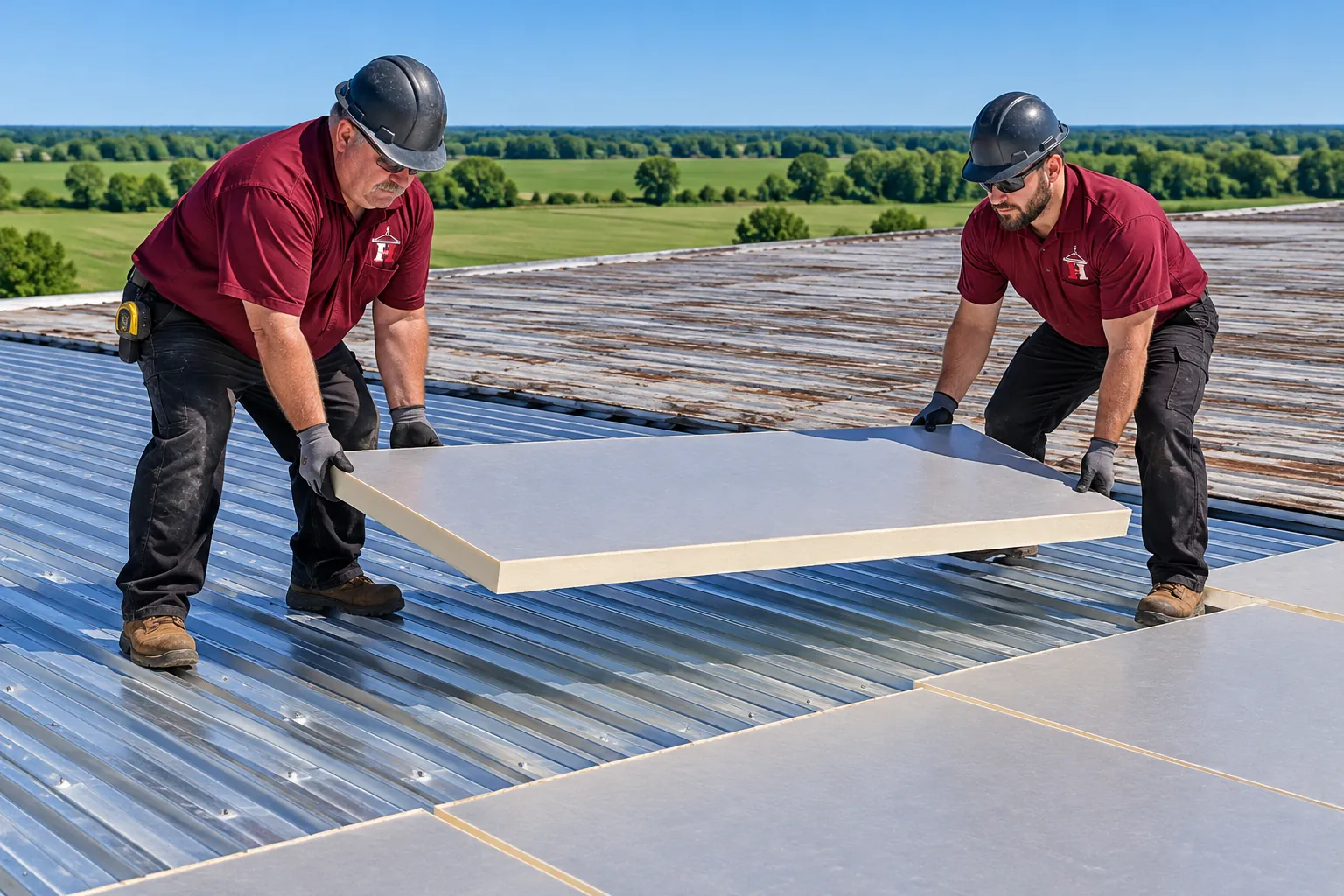
Hired as a Hopkinsville flat roofing contractor, we rebuild low-slope roofs from the deck up, with drainage fixed before the membrane goes on.
A Hopkinsville flat roofing contractor solves drainage first. These are the three ways a low-slope building gets its water off.
On a flat roof, these conditions decide how much of the old roof can stay.
Rings of dried silt and debris lines after heavy rain show the low spots that need more slope.
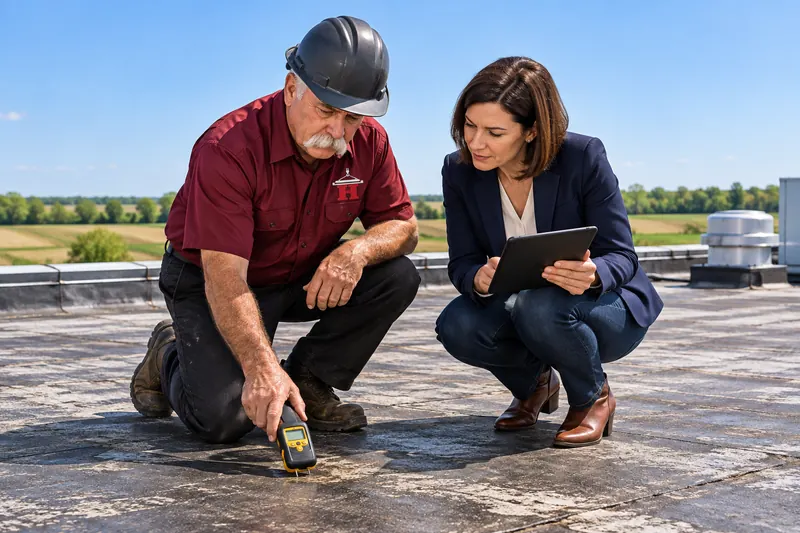
Insulation soaked through a pinhole holds water for years and shows up warm on a night infrared scan.
Without a cover board, hail and foot traffic crush the insulation and leave the membrane sitting in dimples.
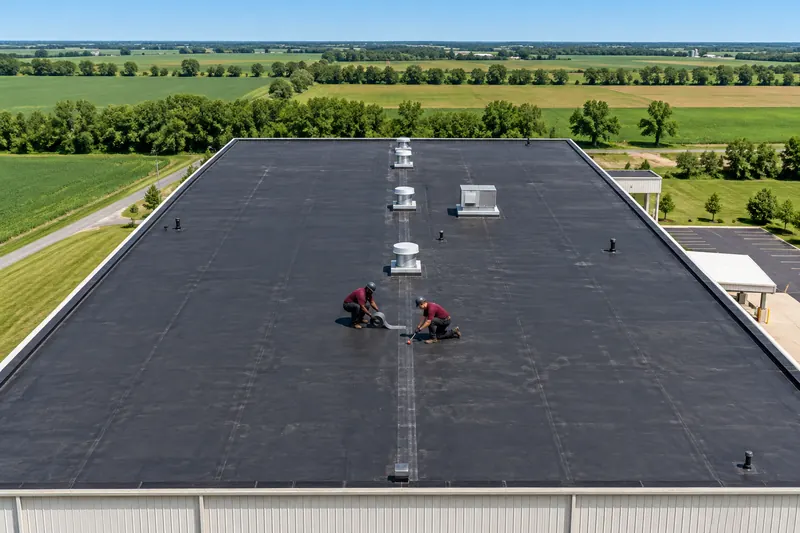
A parapet roof relying on primary drains alone holds water deep when one bowl clogs with leaves.
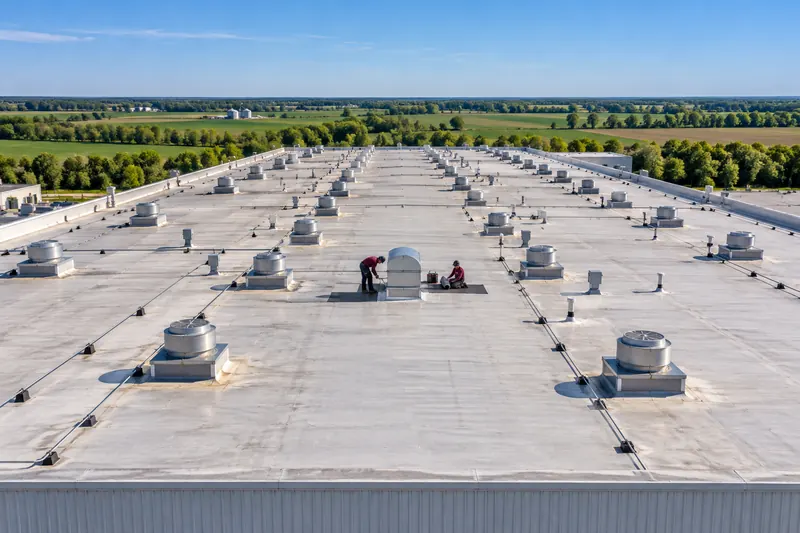
Laps that sit in standing water age faster and start opening in the wettest part of the roof.
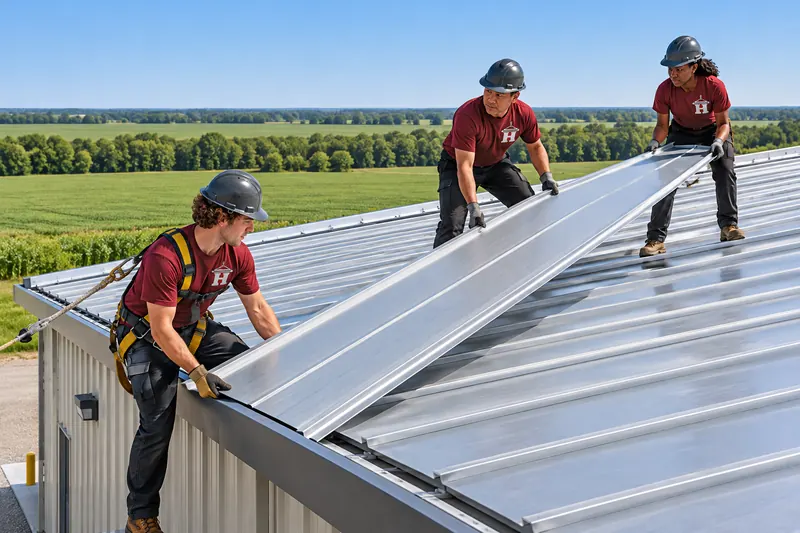
Edge metal set for a thinner roof lets water back up behind it at open eaves.
Rebuilding a flat roof comes down to four choices, made in this order.
Boards are cut and laid from the drain plan, rising from each bowl toward the high points of the roof.
A firm board over the insulation resists hail dents and boot traffic around rooftop units.
Drains get new clamping rings and sumps, and overflow scuppers go through parapets where none exist.
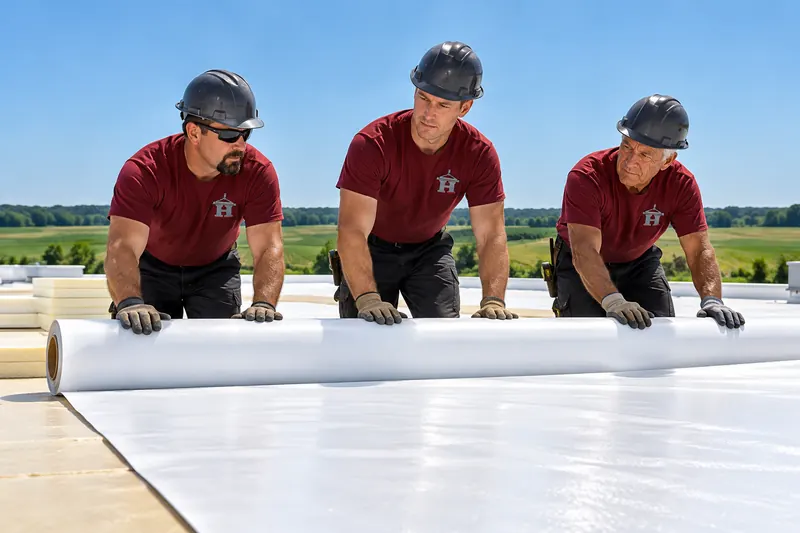
Welded TPO suits roofs with many curbs, and large-sheet EPDM suits wide, plain roofs.
Here is a flat roof before and after the drainage and layers are rebuilt together.
Silt lines mark where water sat. Photos from right after a storm help lay out where the roof needs more slope.
Get A Free EstimateFive decisions, in order, so drainage is settled before any membrane is ordered.
Core cuts and a moisture check map the wet areas, and every drain, scupper, and low spot goes on a roof plan.
Wet sections and roofs already recovered once come off. Dry, attached areas can stay under a recover.
Taper, crickets, saddles, and sumps are laid out from the drain plan, with overflow scuppers added at parapets.
Deck repairs come first, then insulation, tapered boards, and cover board, each fastened into the deck.
Membrane goes on with sealed laps, edges and drains are flashed, and the roof is checked after the next rain.
A flat roof rebuild usually ends in one of these systems.
Welded white TPO over tapered boards covers most rebuilt warehouse and office roofs.
Welded TPO membraneLarge rubber sheets fit wide, plain flat roofs and stay flexible for winter installs.
EPDM rubber membraneA dry flat roof with one or two open laps gets a matched repair instead of a rebuild.
Flat roof seam repairQuestions on ponding, layers, and outlets for low-slope roofs.
By building slope under the membrane. Tapered boards rise from each drain, crickets split water around curbs, saddles keep the valleys between drains moving, and sumps lower the sheet into each bowl. The layout starts from where the drains already sit.
Cover board is a firm layer that spreads the load of hail and boots. Without it, soft insulation crushes around hatches and units, and the membrane ends up sitting in dents that hold water.
Parapet roofs that rely on primary drains alone get them, so water leaves through the wall before it builds up if a drain clogs. Each overflow sits a little above the roof surface at the drain.
Only where the old roof is dry and firmly attached, and only if it has not already been recovered. Core cuts decide it, and the inspector has the final say on layering.
It depends on roof size, the number of curbs and drains, and how much deck needs repair. Work runs section by section, and each section is closed watertight before the crew leaves.
Where the insulation is wet and how much of the roof that covers. Core cuts read the layers at set spots, a capacitance or impedance meter maps readings across a grid, and a night infrared scan picks up warm areas where wet boards hold heat.
Roofs crowded with curbs, pipes, and rooftop units usually get welded TPO, since its flashing details weld to the field sheet. Wide, plain roofs with few penetrations suit EPDM, whose very large sheets cut the number of seams.
Send photos of where the water sits after rain. We will start with the drain plan.
Leave a name and number and we will call you about the roof.
Or call now: (270) 249-6124